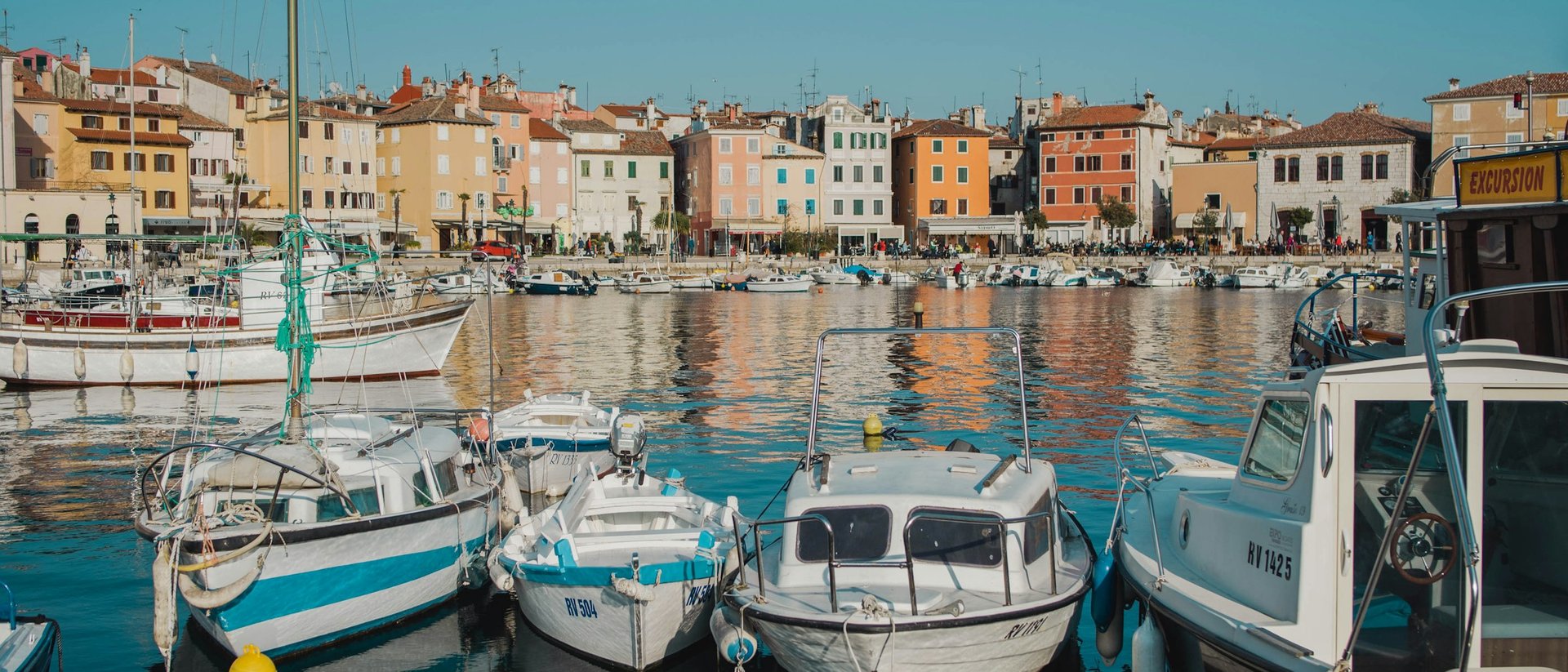
You can enjoy Istria without a car if you choose a well-connected coastal base and plan your day trips around return buses. Pula is the most practical starting point for exploring southern Istria. Rovinj suits a walkable seaside holiday with boat trips, while Poreč works well for the northwestern coast. Visiting hill towns such as Motovun and Grožnjan usually requires more planning or an organised tour.
The choice of accommodation matters as much as the town. Staying within walking distance of a bus station, restaurants and everyday shops makes travelling much simpler. A countryside villa or a remote beach resort can leave you dependent on transfers, even when its address says “Pula” or “Poreč”.
This guide focuses on Croatian Istria and the places you can realistically visit using buses, walking, bicycles and passenger boats. If you are still deciding which places belong on your itinerary, our Istria travel guide covers the peninsula’s towns, landscapes and cultural sights.
Transport information checked in September 2026. Timetables, fares and seasonal services can change. Check both directions for your travel date before booking an excursion.
Where should you stay in Istria without a car?
For a first visit with several day trips, central Pula is my recommendation based on its local bus network, intercity connections, and airport shuttle. Choose Rovinj if you would rather spend more time exploring one town and its coastline. Consider Poreč if your priorities lie farther north.
| Base | Best for | Realistic outings | Main limitation |
|---|---|---|---|
| Pula | A varied holiday with public transport | Rovinj, Fažana and Brijuni, Medulin, Vodnjan, Premantura | Northern Istria involves longer journeys |
| Rovinj | Old-town walks, coastal scenery and boat trips | Pula, Poreč, nearby islands | Inland excursions need extra arrangements |
| Poreč | The northwestern coast and local excursions | Rovinj, Baredine Cave, selected connections towards Novigrad and Umag | A short bus journey does not always mean a convenient day trip |
| Fažana | Beaches, Brijuni and a slower stay | Brijuni and Pula | Regional trips often require travelling through Pula |
| Medulin or Premantura | A holiday centred on the sea | Pula and the surrounding southern coast | Less convenient for exploring the wider region |
These recommendations reflect the transport connections below. They assume you are staying centrally and are comfortable walking between your accommodation, stops and attractions.
Pula: the most practical base for exploring
Pula combines intercity buses with a local network covering nearby coastal settlements. Pulapromet serves places including Fažana, Medulin, Vodnjan and Premantura, making it possible to mix town visits with beach days. Its official route maps are useful when choosing accommodation.
For frequent day trips, look around the Arena and the area between the historic centre and the main bus station. According to Arriva’s Pula bus station information, the station is approximately 800 metres from the Arena. This gives you a manageable walk to regional departures while keeping the centre nearby. The Pula–Rovinj route is one of the most useful connections from here.
Verudela can suit a beach-focused stay, but check the extra local bus journey you will need before each regional excursion.
Rovinj: a good choice for a slower seaside holiday
Rovinj works particularly well when the town itself is a major part of your holiday. You can spend time around the old town and waterfront, then add a boat trip or a bus journey to another coastal town.
The Rovinj bus station is on Trg na Lokvi, within walking distance of the historic peninsula. For easier arrivals with luggage, consider accommodation near the station or the approach to the old town. Check stairs and access carefully before booking a room deep inside the historic streets.
Rovinj is also a useful second base after Pula: the transfer is short enough to avoid losing most of a day. Check the Rovinj–Poreč timetable if you want a northwestern outing from here.
Poreč: useful for the northwestern coast
Poreč offers a central bus station approximately 500 metres from the centre and waterfront. It has connections to Rovinj and Umag, although you need to check whether the departure times allow a worthwhile visit and return. The Poreč–Umag timetable is a useful starting point for planning trips farther north.
There is also a useful local development: from 7 September 2026, Poreč introduced free travel on three electric city-bus routes, serving areas including Nova Vas, Červar Porat and Baderna. Check the current timetable and stops on the City of Poreč transport page.
For accommodation outside the centre, check the actual walking distance to a stop and the last return service. A resort’s seasonal boat or tourist train should also be checked for your dates.
What can you actually visit without a car?
The following journey times describe the transport leg. They do not include walking to the station, waiting, or reaching the attraction after arrival.
| Trip | Transport | Approximate journey | What to check |
|---|---|---|---|
| Pula → Rovinj | Intercity bus | Around 35–45 minutes on listed services | Return departure |
| Rovinj → Poreč | Intercity bus | Around 45–50 minutes | Time available before the return |
| Pula → Poreč | Intercity bus | Around 90 minutes | Whether the journey leaves enough sightseeing time |
| Pula → Fažana → Brijuni | Local bus and official park boat | Boat crossing around 15 minutes | Bus and booked boat departure |
| Pula → Premantura → Kamenjak | Local bus, then walking or cycling | Depends on the bus and chosen beach | Day of operation and distance beyond the stop |
| Poreč → Baredine Cave | Bus to Nova Vas, then walking | About 1 km on foot after the stop | Bus return and cave opening times |
| Pula → Pazin | Intercity bus | Around 50 minutes according to the operator | Actual departures for the day |
| Labin → Rabac | Bus | Around 25–30 minutes according to the operator | Connections if starting elsewhere |
The main intercity estimates come from Arriva’s published routes for Pula–Rovinj, Rovinj–Poreč and Pula–Poreč. Individual departures and traffic conditions affect travel times.
Fažana and Brijuni from Pula
Brijuni is a realistic excursion without a car: travel to Fažana, then take the official National Park boat to Veliki Brijun.
Pulapromet’s route 21 serves Fažana. From there, the park boat takes approximately 15 minutes. Tickets can be purchased through the park’s official channels. Use the Pulapromet route information and the official Brijuni arrival instructions to coordinate the two parts of your journey.
Allow a buffer between your bus arrival and the booked departure. When comparing excursions, check the itinerary carefully: a cruise around the archipelago and a visit that includes landing and sightseeing are different experiences.
Premantura and Cape Kamenjak from Pula
The bus takes you to Premantura. Exploring Kamenjak continues on foot or by bicycle.
Pulapromet’s route 28 connects Pula with Premantura. The timetable varies by day and season, so check your outbound and return services together using the timetable section on the Pulapromet website.
Once you arrive, choose how much of the peninsula you actually want to cover. A nearby stretch of coast and a long outing to the southern tip require very different amounts of walking. For several stops, consider arranging a suitable bicycle locally.
Use the official Kamenjak visitor information and map to plan your route. Bring water, sun protection and suitable footwear, and leave enough time to get back to the bus.
Kamenjak is a protected area; it should not be confused with a Croatian national park.
Rovinj as a day trip from Pula
Pula–Rovinj is one of the more straightforward regional trips. Listed bus journeys commonly take around 35–45 minutes, and Rovinj’s station is within walking distance of the old town. Check the Pula–Rovinj departures and return options before settling on your sightseeing plans.
Keep the day simple: explore Rovinj, have lunch and leave room for the waterfront. Adding another town can turn an easy outing into a sequence of connections.
If you want dinner and an evening in Rovinj, check the return bus before deciding. Staying overnight may suit your plans better.
Baredine Cave from Poreč
Baredine is a useful option when you want an excursion beyond the coast.
Baredine Cave’s official arrival instructions describe taking a bus towards Višnjan, getting off at Nova Vas and walking approximately one kilometre to the cave. Check the current service and allow for the walk in both directions.
This is the kind of detail that matters when travelling without a car: the final walk is part of the outing, rather than something to discover after stepping off the bus.
Pazin from Pula
Pazin provides an option for visiting inland Istria. Arriva advertises a daily, year-round connection from Pula, with a journey of about 50 minutes. Confirm the actual departures using the Pula–Pazin bus information before planning the day.
Keep the visit focused on Pazin itself. Reaching the town does not automatically give you convenient onward transport to the surrounding villages or countryside.
Rabac via Labin
Rabac is possible with planning, particularly if you are already staying in Labin. Arriva lists a bus connection between the two, with an approximate journey time of 25–30 minutes. Check the Labin–Rabac timetable for your date.
If you are coming from Pula, work backwards from your return journey. You need both the Rabac–Labin leg and the onward bus to fit.
Islands from Rovinj
Boat trips add variety without requiring another overland journey. Maistra lists a roughly 15-minute crossing from Rovinj to Sveti Andrija, with boats almost hourly in its published timetable.
Check the Rovinj–Sveti Andrija boat schedule for your dates, particularly outside the main visitor season.
Can you visit Motovun and Grožnjan without a car?
An organised excursion or a prearranged driver is the more practical option for visiting both hill towns in one day.
Motovun does have an advertised bus route from Poreč. Arriva describes the journey as approximately 40 minutes and lists the stop as Kanal. However, the Poreč–Motovun route page does not establish that you can travel out, spend several hours there and return conveniently on your chosen date.
Before attempting it independently, confirm:
- A bookable outbound departure for your date.
- A usable return departure.
- The exact stop and onward access to the hilltop.
- Enough time for the visit between those services.
I would not build a short holiday around unconfirmed public transport to Grožnjan, Hum or Oprtalj. For these places, look for an excursion with pickup accessible from your accommodation. The same approach suits visits to rural wineries and countryside restaurants.
If a food experience is high on your list, read our guide to what truffle hunting in Istria is actually like. Before booking, ask the provider where you need to meet and whether transport is included. A place on the activity does not necessarily include a ride from your coastal accommodation.
Do trains help with travelling around Istria?
Trains have a role, but they are not the backbone of a coastal itinerary.
Rail services run through parts of inland Istria, including connections involving Pula and Buzet. They do not provide a convenient coastal link between Pula, Rovinj and Poreč. The HŽPP cross-border train information also includes detailed operating dates and exceptions.
Use the train when a particular journey suits your plans. Check the operator’s current timetable and service notices rather than assuming a railway station is close to the historic centre you want to visit.
A realistic seven-day Istria itinerary without a car
For a first visit, consider four nights in Pula followed by three nights in Rovinj. This suggested itinerary leaves room for sightseeing, transport and a slower day.
| Day | Plan | Overnight base |
|---|---|---|
| 1 | Arrive and explore central Pula | Pula |
| 2 | Fažana and a booked Brijuni visit | Pula |
| 3 | Premantura and a manageable Kamenjak walk or cycle | Pula |
| 4 | Pula beach day, or an outing to Vodnjan | Pula |
| 5 | Transfer to Rovinj and explore the town | Rovinj |
| 6 | Choose a boat trip or a bus outing to Poreč | Rovinj |
| 7 | A prebooked inland tour, or another day around Rovinj | Rovinj |
Arrange the Kamenjak day around the operating timetable. If you have an early flight from Pula after this itinerary, check the transfer carefully; spending the final night in Pula may be easier.
Choose Poreč instead of Rovinj for the second base if Baredine Cave and the northwestern coast are your priorities. For a shorter trip, staying entirely in Pula reduces packing and transfers.
If you are still deciding between a week in Istria and a broader Croatian route, compare this plan with our seven-day Croatia itinerary for solo women. Treat them as alternative starting points rather than trying to squeeze both into one week.
How to plan buses, tickets and airport transport
The official Pula Airport shuttle connects the airport with Pula’s main bus station. The published fare is €6, with cash and card payment accepted. Airport departures are described as approximately 30 minutes after aircraft arrival; check the airport’s schedule for your flight.
For journeys around Pula, use Pulapromet’s Mobility Plus app, which offers timetables, ticket purchases, journey planning and live bus locations. You can find the app through the Pulapromet website.
At the time of checking, Pulapromet’s daily and multi-day passes cost €5 for 24 hours, €10 for 72 hours and €20 for 168 hours, covering unlimited travel within its three tariff zones. These are local-network passes, so budget separately for intercity journeys and airport transport.
For regional buses, check the operator’s date-specific booking results. According to Arriva’s booking guidance, online tickets generally include a reservation for the selected journey; open-return tickets require a later return reservation.
Before every day trip, check the return, the stop location and the operating day. Save your ticket and timetable where you can access them without a connection. For the wider practicalities of your visit, our Croatia travel tips for solo female travellers will help you prepare.
Travelling alone in Istria without a car
When you travel alone, a missed connection can mean paying for the entire taxi fare yourself. Leave room in your budget for an occasional transfer, especially when your plans depend on the last bus of the day.
Choose accommodation with a straightforward walking route from your arrival point. If you expect to arrive late, ask your host about check-in and the route from the station before travelling. Our guide to solo female travel safety in Croatia covers broader considerations for exploring independently.
If you would prefer company and a planned itinerary, take a look at Girls Do Istria, our women-only group trip. Review the itinerary, meeting point and transport inclusions to see whether the format fits the holiday you want.