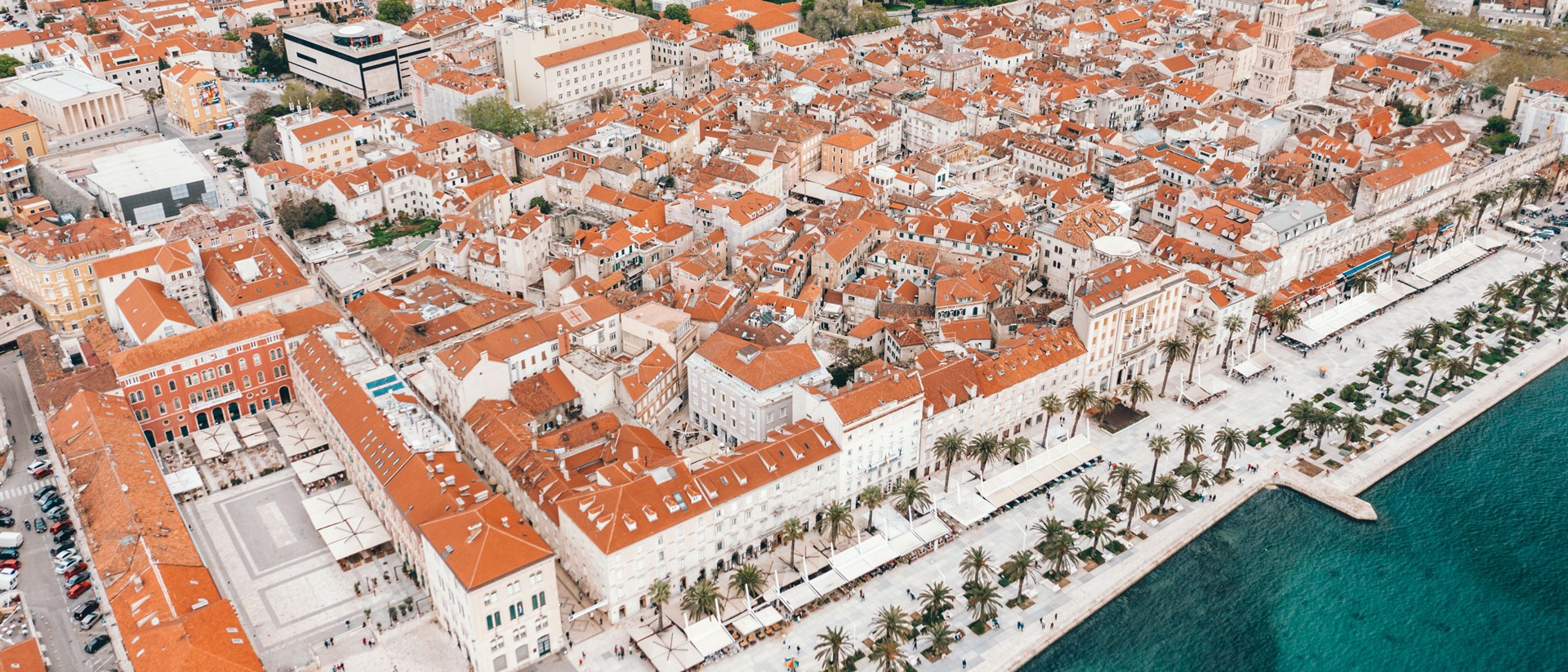
Yes, Split is one of the safest cities in Europe for solo female travellers. Croatia consistently sits in the top 25 of the Global Peace Index, violent crime against tourists is genuinely rare, and the whole culture of the Dalmatian coast is built around being outside until late. On a warm evening, the Riva is full of families, grandmas with ice creams and kids kicking footballs about at 11 pm. It’s very hard to feel unsafe in a city where half the population seems to be out for a stroll after dark.
That said, “safe” doesn’t mean “switch your brain off”. There are a few things worth knowing before you go: taxi tricks at the ferry port, which cash machines to avoid, what the old town alleys are like at 2 am, and that’s exactly what this guide to Split is for. It covers everything a friend would tell you before your first solo trip: the best things to do in Split alone, where to stay, day trips, costs, and the little cultural quirks nobody warns you about.
Grab a coffee. This is a long one.
Is Split safe for solo female travellers? The honest answer
Croatia holds the lowest possible risk rating from both the UK Foreign Office and the US State Department. Locals in Split will happily tell you that kids play out in the streets until midnight, and plenty of people barely bother locking their doors. Copying that last habit isn’t advisable, but it tells you a lot about the general vibe of the city.
As a woman on your own, the thing you’ll probably notice most is what’s missing. The constant catcalling you get in some Mediterranean destinations? Largely absent here. Aggressive street sellers? Barely any. Walking back to your apartment through the old town at midnight is completely ordinary, and the scariest thing most women meet on that walk is a very confident seagull.
The real risks in Split are the boring ones: pickpockets in the packed lanes of Diocletian’s Palace in July and August, drinks left unattended in clubs, and the occasional opportunist eyeing up an unattended phone on the beach. Standard city stuff, in other words. If you’ve ever navigated a Saturday night in Manchester, you’ll be absolutely fine in Split.
To be completely honest: the atmosphere shifts a little at the height of summer. When the cruise ships and party boats roll in, the old town gets rowdier at night, mostly thanks to visitors rather than locals. It rarely feels threatening, just louder and drunker. If that’s not your scene, September will treat you beautifully (more on timing later).
What should solo female travellers avoid in Split?
Unofficial taxis at the ferry port and bus station
This is the classic Split tourist trap. Someone sidles up murmuring “taxi?” and quotes a flat rate of €40 for a journey that should cost a tenner. Use Uber or Bolt instead; both work brilliantly in Split, and the price is agreed before you get in. If you do take a regular taxi, make sure the meter is running. More on this in our Croatia travel tips for solo women.
Euronet ATMs
The bright blue and yellow cash machines dotted around the old town charge painful fees and offer dreadful exchange rates. Walk a couple of minutes to a proper bank machine and keep your money for gelato instead.
Dark, empty alleys at 2 am
The old town is a glorious maze, and most of it is beautifully lit and busy late into the evening. But a few backstreets between the palace and Varoš get very quiet and very dim after the bars empty. Stick to the main arteries when you’re heading home late. This is less about danger and more about not wanting to get lost in a stone labyrinth in the dark.
Leaving valuables on the beach
Bačvice in high season is essentially a festival crowd on sand. Take a dry bag for your phone and cash, or just bring the minimum.
Restaurant menus with no prices
Rare, but if a waterfront place won’t show you prices clearly, eat elsewhere. The best food in Split is a few streets back from the Riva anyway.
Ultra week, if big party crowds aren’t your thing
For a few days each July, Ultra Europe takes over the city, and Split becomes one giant afterparty. Some solo travellers love it; it’s an easy place to make friends. Others prefer to schedule around it.
And that’s genuinely it. No no-go districts or “never do this after dark” list. Split just doesn’t have them.
The best things to do in Split alone
Right, the fun bit. Split is compact, walkable and endlessly photogenic, which makes it a dream for exploring at your own pace. No negotiating with a travel buddy about whether it’s museum o’clock or beach o’clock.
Get lost in Diocletian’s Palace
The old town of Split isn’t next to a Roman ruin; it IS one. Roman emperor Diocletian built his retirement palace here in the 4th century, and 1,700 years later people still live, work and hang laundry inside its walls. The whole thing is a UNESCO World Heritage site, and it’s completely free to wander because it’s simply… the city.
Start at the Peristyle (the main square, complete with a 3,500-year-old Egyptian sphinx, casually), and walk through the palace cellars. Game of Thrones fans will recognise where Daenerys kept her dragons. And then let yourself get lost. The moment you take a wrong turn and end up in a tiny courtyard with washing lines overhead and a cat judging you from a windowsill is the moment Split gets under your skin.
An early-ish walking tour is a brilliant first-morning move when you're travelling solo. You get the history, your bearings, and usually a few "want to grab lunch after?" conversations out of it. Book one for your first day and the rest of the trip gets easier.
Climb the bell tower of St Domnius
The cathedral’s bell tower is the icon of Split, and climbing it is one of the best things to do in the whole city. The staircase is steep, partly metal, and slightly wobbly in a character-building way, but the view from the top is ridiculous. Orange rooftops, the harbour, the islands floating on the horizon, mountains behind. It’s the kind of view that keeps people up there far longer than they planned.
A cathedral and bell tower ticket costs around €7, or there’s a combo ticket for about €12 that adds the crypt, baptistery, and treasury. Cash is handy here. Go early or late to dodge both the queues and the midday sun.
Hike up Marjan hill
Locals call Marjan the lungs of Split, a big green peninsula of pine forest right next to the old town, criss-crossed with trails. The climb up the stone steps from Varoš is sweaty in summer but takes maybe 20 minutes to the first viewpoint, where there’s a café terrace (Teraca Vidilica) with the best-value view in the city. Keep going to the very top, Telegrin, where the Croatian flag flies at 178 metres, and the whole Dalmatian coast opens up beneath you.
There’s no reason for a solo female traveller to feel uneasy up there. It’s popular with local joggers, dog walkers and grandads doing their daily constitutional. Go for sunset if you can. Bring water.
Have a proper beach day
Split has actual city beaches, which still feels like cheating. Bačvice is the famous one, sandy, shallow, five minutes from the centre, and it’s where you’ll see locals playing picigin, a uniquely Split sport that involves keeping a tiny ball out of the water while flinging yourself around in the shallows. Watching it is free entertainment for hours.
For something prettier and calmer, walk or hop on the number 12 bus around Marjan to Kašjuni, a pebbly bay backed by pine trees with water so clear it doesn’t look real. Ježinac and Bene are lovely quieter options on the same peninsula, and the newly done-up Žnjan stretch east of the centre is great if you want more facilities.
The sea floor is mostly pebbles and the occasional sea urchin. Pack swim shoes. Your future self says thank you.
Do as the locals do: coffee, markets and fjaka
If there’s one word to learn before travelling to Split, it’s fjaka, the sacred Dalmatian art of doing absolutely nothing, ideally with a coffee, ideally for two hours. Solo travel is the perfect excuse to master it. Order a white coffee on a square, watch the world drift past, and refuse to feel guilty.
For the full local morning: browse the Pazar green market by the palace’s Silver Gate for peaches and figs, stick your nose into the fish market (Peškarija), then grab a pastry from a bakery and find a sunny wall to sit on. Total cost: pocket change. Total joy: enormous.
In the evening, skip the fancy cocktail bars for at least one night and do what Split does: buy a cold drink from a shop and sit on the stone wall at Matejuška, the little fishermen’s harbour at the end of the Riva, watching the sunset with half the city’s twenty-somethings. If you’d rather have a roof and a chair, Marvlvs Library Jazz Bar inside the palace is tiny, candlelit and wonderful, and nobody bats an eyelid at a woman reading a book alone with a glass of wine.
Eat well
Solo dining in Split is easy. Konobas, small traditional taverns, are casual, friendly and used to single diners. Order black risotto if you’re brave (squid ink, delicious, will temporarily dye your teeth grey). Maybe not a first-date dish, but you’re solo, so who cares. Or look out for peka, meat or octopus slow-baked under an iron bell.
At lunchtime, follow office workers to wherever serves marenda, the cheap, hearty set lunch that Dalmatians treat as a basic human right. It’s the best-value meal in the city. And whatever you do, leave room for ice cream. Luka Ice Cream near the palace has queues for a reason.
If eating alone still feels like the intimidating bit of solo travel, book a small-group food tour early in your trip. You get fed properly, you learn what to order for the rest of the week, and you spend two hours with a handful of other travellers, which usually solves the dinner question for the following night too.
Pharmacies, periods and the practical stuff nobody writes about
Pharmacies are called ljekarna, and you’ll spot them by a green cross. Croatian pharmacists are excellent, speak good English, and function as the first line of healthcare here. You can walk in without an appointment and ask about a rash, a bad stomach or a mystery bite, and they’ll either sort you out or tell you to see a doctor. There’s always at least one pharmacy on 24-hour duty in the city; any closed pharmacy has the current “dežurna ljekarna” (duty pharmacy) posted in the window.
Period products are easy. Supermarkets, dm and Müller all stock pads and tampons at normal European prices. Two caveats worth knowing: applicator tampons are much less common here than in the UK, so if that’s your preference, bring a box. Menstrual cups are hard to find outside big drugstores; pack your own.
Cystitis and UTIs deserve a mention because summer in Dalmatia is practically designed to cause them: heat, dehydration, hours in seawater, sitting around in a damp swimsuit. Antibiotics require a prescription in Croatia, so if you’re prone to them, bring whatever your GP normally gives you, plus sachets or D-mannose from home. Pharmacies do stock over-the-counter relief products, but you don’t want to be hunting for them at midnight. Drink far more water than feels necessary and change out of your swimsuit.
Emergency contraception is available in Croatian pharmacies without a prescription. One honest heads-up: individual pharmacists have the legal right to refuse on grounds of conscientious objection, and occasionally do. It’s not common, and it isn’t a reason to worry, but if it happens to you, it’s not personal, and it’s not a legal barrier. Simply go to the next pharmacy, of which there are plenty in central Split.
Day trips from Split you can easily do solo
This is Split’s superpower: it’s the transport hub of the Dalmatian coast, so you can base yourself in one apartment and see half of Croatia on day trips. No car needed for most of it.
The islands
Ferries and catamarans leave from the harbour right in front of the old town. Hvar is the glamorous one. Lavender fields, a Venetian fortress above the harbour, and a beach club scene if you fancy an afternoon of sunbeds and a spritz. The catamaran to Hvar Town takes about an hour, which makes it a very doable day: morning boat, fortress climb, long lunch, swim, evening boat home. Brač has Zlatni Rat, the famous horn-shaped beach.
Šolta is the sleepy, back-in-time option. Half-day and full-day boat tours also run to the Blue Lagoon and around the islands; a small-group day tour is one of the easiest ways to meet people as a solo traveller, because three hours on a boat with strangers turns them into non-strangers remarkably fast.
Krka National Park
About 90 minutes away, Krka is a chain of emerald pools and waterfalls that look Photoshopped in the best way. Organised tours handle all the logistics, or you can do it independently by bus via Skradin. Go early in summer; the boardwalks get busy.
Trogir
A tiny UNESCO-listed medieval town 30 minutes up the coast that feels like a pocket-sized Split. Ridiculously pretty around sunset.
Klis fortress
Twenty minutes inland, perched on a ridge with epic views. Game of Thrones’ Meereen, if you’re a fan.
Plitvice Lakes National Park
Croatia’s most famous national park, with its chain of sixteen terraced lakes, is doable as a (long) day trip, though at over two hours each way it’s honestly better saved for the journey onward towards Zagreb if you can.
And if you’re continuing south, the Split to Dubrovnik route is a classic. Sit on the right-hand side. That’s the sea side, and the coastal stretch is a free scenic tour. There’s also a seasonal catamaran that stops at islands on the way if you’d rather travel by water. For how Dubrovnik compares as a base, see our best places in Croatia for solo women guide.
Where to stay in Split as a solo female traveller
The golden rule: stay central. Split’s charm is being able to wander out of your door into 1,700 years of history, and the walk home at night is shorter and busier.
Old town / Diocletian’s Palace
Sleeping inside a Roman palace is objectively cool, and you’re in the middle of everything. The trade-off is noise; bars echo through those stone lanes until late, especially in summer. Pack earplugs.
Varoš
The pick of the three for most solo travellers. The old fishermen’s quarter just west of the centre is all crooked stone cottages and green shutters, two minutes from the Riva but noticeably calmer at night. Lots of lovely guesthouses and apartments here.
Bačvice
East of the centre, near the beach and the main bus and train stations. Handy for early ferries and day trips; livelier (read: clubbier) at night.
For accommodation itself, Split’s hostel scene is genuinely good for solo women. Several places offer female-only dorms with proper lockers and sociable common areas, and hostels remain the single easiest way to find company for dinner or a boat trip.
If dorm life isn’t your thing anymore, small family-run guesthouses and studio apartments in Varoš hit the sweet spot of privacy, safety and price. Whatever you book, check reviews specifically from solo female travellers; they’ll mention things like lighting on the street outside and whether reception is 24-hour, which glossy photos never show.
Booking somewhere with a host who actually lives on site is one of the best solo travel hacks going. You get local restaurant tips, someone who notices your comings and goings in a good way, and usually a much warmer welcome.
What to pack and what to wear in Split
Shoes first, because this is the one people get wrong. Split’s streets are limestone polished by seventeen centuries of foot traffic, and in the rain they turn into an ice rink. Bring grippy trainers or sandals with proper soles and leave the smooth-bottomed ones at home. Add swim shoes for the pebble beaches and the occasional sea urchin.
Beyond that: a light scarf or a shirt you can throw on for the cathedral, where shoulders and knees need covering. A cross-body bag that zips shut, which is more useful than a backpack in the crowded summer lanes. A dry bag or waterproof pouch for the beach and boat days. A light jumper or jacket, because evening catamarans and September nights are cooler than you’d expect from the daytime heat. A refillable water bottle. Sunscreen bought in a supermarket rather than a souvenir shop.
Now the question nobody puts in a packing list but plenty of women think about: what can you actually wear here without attracting attention? The answer is essentially anything. Split is a Mediterranean summer city, locals dress well and dress light, sundresses and shorts are everywhere, and walking from the beach to a café in a cover-up over your swimsuit is completely normal. The only genuine dress code is inside churches.
The same goes for the beaches. Croatian beaches are refreshingly unbothered, every age and every body shape, families and pensioners and teenagers all sharing the same stretch of pebbles. Topless sunbathing is legal, and you’ll see some of it, but it’s not expected, and nobody registers either choice.
Getting to Split (and getting around)
Split airport is about 25 kilometres from the centre, near Trogir. The cheapest transfer is the local number 37 bus at around €3, the airport shuttle bus into town costs about €6, and Uber or Bolt will run you somewhere in the €30–40 range depending on season and traffic. After a night flight, the shuttle is the sweet spot.
Once you’re in the city, your feet do most of the work. The old town is pedestrianised, and everything central is within a 20-minute walk. City buses (around €2 a ride) cover the beaches and suburbs, and Bolt is cheap enough for lazy evenings. You genuinely don’t need to rent a car unless you’re planning to explore the mountains or tiny coastal villages beyond the bus routes.
Ferries deserve a special mention because they’re practically public transport here. Jadrolinija and Krilo boats connect Split to the islands multiple times a day in season, and buying tickets is straightforward, though for summer catamarans to Hvar, book a day or two ahead.
Oh, and one boring-but-important thing: get travel insurance sorted before you fly. Croatia is in the EU (and uses the euro), so UK travellers should carry a GHIC too, but insurance is what covers you when your phone goes for a swim or a scooter argument goes wrong.
How to meet people in Split (and the case for going women-only)
“Solo” doesn’t have to mean “alone the whole time”, unless you want it to, which is also completely valid.
Split makes company easy. Hostel common rooms, free walking tours, boat trips, cooking classes — all of them are basically friendship vending machines. The Riva itself works too; entire evenings have been known to unfold from an “is this seat taken?” at sunset.
If you’re feeling nervous about your first solo trip, by the way: that’s completely normal, and it doesn’t mean you’ve picked the wrong destination. The best move is to book one organised day tour early on, a boat trip or a Krka day, as a safety net. Having one day where somebody else handles the logistics takes the pressure off, and by the time it’s over you’ll usually have the confidence (and often the company) to wing the rest.
If you’d like the structure sorted for you, this is where women-only group tours shine, especially for a first solo trip. Travelling with a small group of women — whether that’s a sailing trip along the Dalmatian coast, island hopping out of Split, or a week exploring further north in Istria — gives you built-in company, a local guide who handles the logistics, and the confidence boost of arriving somewhere new with your people already around you. The shyest woman on day one has a habit of turning into the ringleader by day three. It happens on practically every trip.
The honest recommendation: do a mix. A few days exploring Split alone, then a group tour for the islands or the sailing. You get the independence and the friendships.
Best time to visit Split, Croatia
Shoulder season is always worth banging the drum for. May, June and September give you sunshine, warm sea, open restaurants and ferries, but without July and August’s crowds, peak prices and 35-degree pavement-melting heat.
July and August are full-throttle: brilliant if you want nightlife and maximum boat options, less brilliant if queues make you twitchy. October is the quiet favourite. The city still has a lively but unhurried feel, cafés full, Riva busy at sunset, just without the summer scrum, and it’s often still 20 degrees and sunny. Some island businesses start winding down, so check ferry timetables. Winter Split is peaceful and moody and belongs to the locals; magical in its own way, but pack for rain and don’t expect to swim.
For a first solo trip, early June or September wins every time.
How many days do you need?
Two full days cover Split itself comfortably: one for the palace, bell tower and old town, one for Marjan and the beaches. Three nights is the number most solo travellers land on, and they’re right; it’s enough to see the city and squeeze in a day trip without that permanently rushed feeling.
That said, the whole point of Split is using it as a base. Given the choice, four or five days is the better call: two in the city, one island day, one Krka waterfalls day, and one glorious day of doing very little except fjaka and swimming. Our solo female travel guide to Croatia has more on pacing a longer trip.
Things worth knowing before a first trip to Croatia
- Tap water is completely safe to drink. Bring a refillable bottle and save your euros for ice cream.
- Cash still matters. Cards work almost everywhere, but markets, some konobas and the odd ticket office prefer cash. Small notes are your friend.
- Croatians switch to excellent English instantly, but a cheery “dobar dan” (good day) and “hvala” (thank you) earn you genuine warmth. “Pomalo”, meaning roughly “take it easy”, is the unofficial motto of Dalmatia, and you should adopt it immediately.
- Cover shoulders and knees for the cathedral. A light scarf in your bag solves this.
- Sundays and mid-afternoons are quiet. Shops close, locals nap or head to the beach. Plan around it rather than fighting it.
- The stone streets are polished to an ice-rink shine. Leave the slippery-soled sandals at home; this is a trainers-and-grippy-sandals city.
- Emergencies: 112 works for everything, and there’s a tourist police presence in season around the old town.
Split or Dubrovnik, which should you pick?
The eternal Croatia question. Dubrovnik is the more jaw-dropping film set: those walls, that old town, King’s Landing in the flesh. But it’s smaller, pricier, and in high season the crowds are intense. Split feels like a real, living city that happens to be built inside a Roman palace, with better transport links, better value, better beaches within walking distance, and far more day-trip options.
For a solo female traveller, Split takes the edge as a base, hands down. Then do Dubrovnik as a night or two at the end if your itinerary allows. That way you get the postcard AND the city with a pulse. We compare all seven top spots in our destinations guide.
Is Split worth it for solo female travel?
A resounding yes. Split gives you that rare combination: a city safe enough that you stop thinking about safety, beautiful enough that your camera roll fills up embarrassingly fast, and sociable enough that you’re never alone unless you choose to be. Add the islands, the waterfalls of Krka, and the whole Dalmatian coast on your doorstep, and it’s genuinely hard to design a better solo destination.
Go for the Roman palace. Stay for the fjaka. Come home already planning the next trip, because Croatia does that to people.